

Having been carving for nearly 40 years I’ve spent a considerable amount of time looking for the single perfect combination of blade length, shape and grind profile to give me the perfect woodcarving knife.
I have tried wharncliffe style blades, puuko shaped ones and purpose made, so called, woodcarving knives. I’ve made umpteen different knives and have finally reached a conclusion.
There is no such thing as THE perfect woodcarving knife.
There are perfect knives for diferent hands, carving styles, subjects and woods. A large, and by large I mean any knife with a blade length of more than say 50mm, knife might be great for spoon carving when using green wood but would be just too big for any kind of fine work with seasoned timber. The simple fact is that not only do differing timbers at differing moisture contents demand different types of cut, so do differing subjects. You would not, for instance use the same carving style for a netsuke sized (50mm ish dia) carving in seasoned Boxwood as you would for a spoon in green Birch. Or a caricature carved in Lime for example.
The first demands very small, short cutting strokes, removing thin slivers. The second often benefits from long sweeping cuts removing larger amounts of wood with each stroke. And for the third you would often use short but quite deep cuts as the wood is relatively soft even when seasoned.
I have often spent an entire hour carving a small piece of Box and produced less chips than would fill an egg-cup. The same amount of time with green-wood carving might result in 2-3 spoons being roughed out and well on their way to being finished. The amount of waste wood also being massively greater.
So, when I hear or read comments about a particular kind of knife being “The best carving knife” I usually retort that it might be the best carving knife ever “But usually only for one or maybe two styles of carving and timber species/moisture content”. More to the point it is ultimately a matter of opinion.
I firmly believe that there is only one set of circumstances in which a single blade could possibly be considered “the” perfect knife. Those circumstances are that the person using it only does one kind of carving in one type of timber. For example, for someone who only carves spoons and bowls and predominantly from green wood then a 3 inch (75mm) long scandinavian grind sloyd knife might be that perfect knife.
But, as soon as that same carver decides to carve a small figure out of Lime (Basswood for our American cousins). The sheer length of the knife for a carving style that demands the use of the tip of the blade makes that same knife less than ideal.
Let’s look at the idea of grind, I have read many facebook posts, comments, blogs and indeed the great Ray talking about Scandi, Scaninavian, zero grind knives being the best. In those same posts, comments etc, a variety of spoon knives or crook knives also have their virtues extolled. Well, I have yet to see a spoon knife that does not have a convex grind on it’s outer face. Why is that and why, if scandi is best do spoon knives not also have that same grind. The answer is because they are expected to produce, curved, scooping cuts and a flat “scandi” edge profile would not lend itself to that. What happens I say when you want to use your straight bladed knife for similar curved, scooping cuts? My answer is that the “Scandi” then becomes less than ideal.
Consider if you will, woodcarving gouges and the diference between them and a carpenter’s chisels. The answer comes partly in the fact that there is a kind of grind named after the carpenter’s chisel. Chisel grind means flat on one side with a single bevel on the other. Chisels are fabulous for straight, flat cuts but as soon as you want to make a curving, scooping cut, you would revert to the carver’s gouge. Gouges tend to have convex grinds and often that convexity is accentuated further by the gouge itself being curved. You only need to look at specific spoon and bowl gouges to see this curvature at it’s most extreme.
My position is, therefore that the most versatile knife for carving is one which has a shallow but convex grind. Able to take off thin slivers and also to scoop out rounded cuts. Convex grind knives are also. Easier to sharpen, requiring less metal to be removed. The blade needs to be short enough to be able to use it’s tip but long enough for broad sweeping cuts.
My position is now, and is likely to remain, that there is no one knife that is perfect for every cut. And the same goes for grind as well. Scandi grind is great for many styles but not all. Etc.. Etc… But, you can find a happy compromise.. And here is mine.
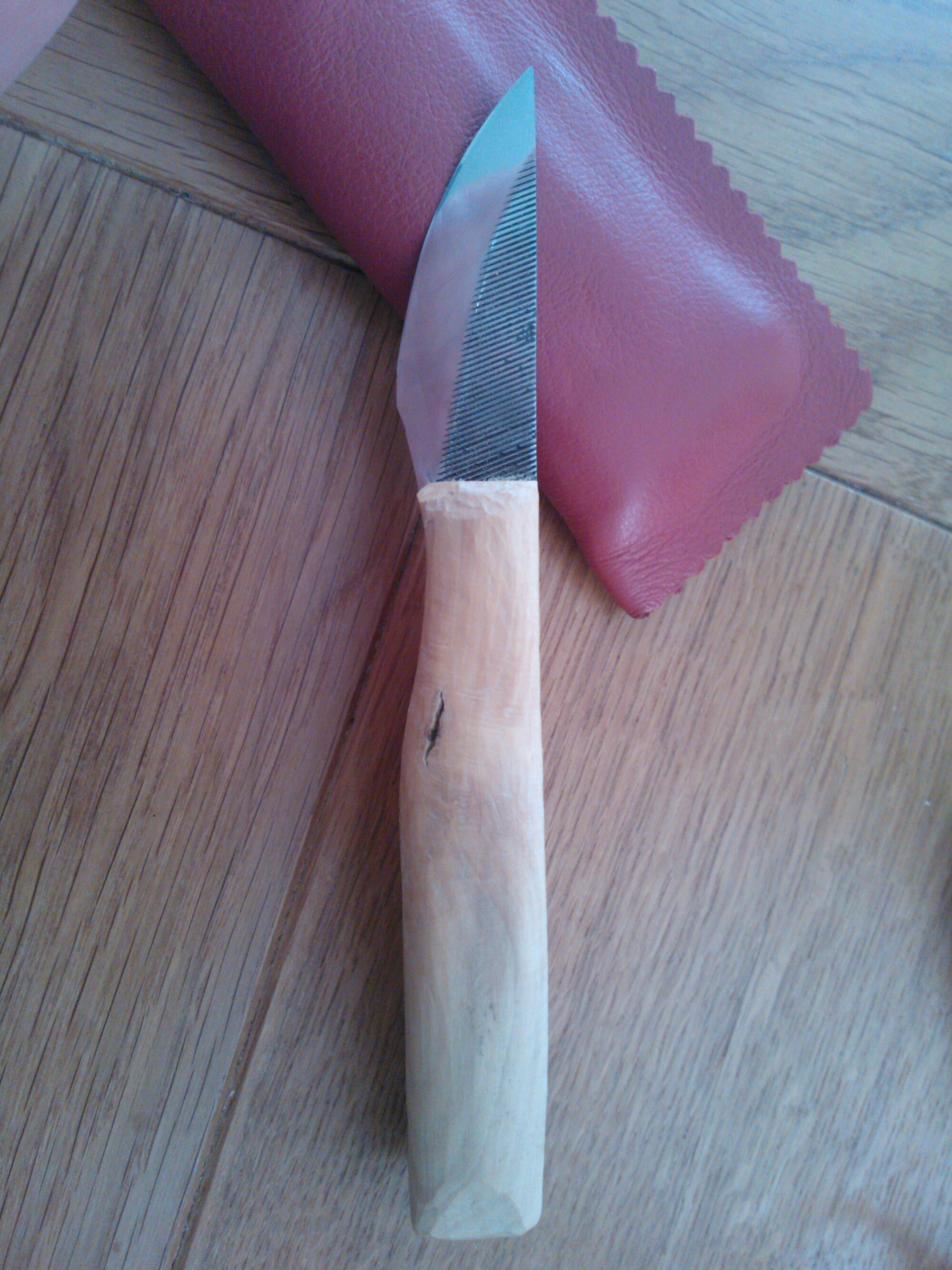
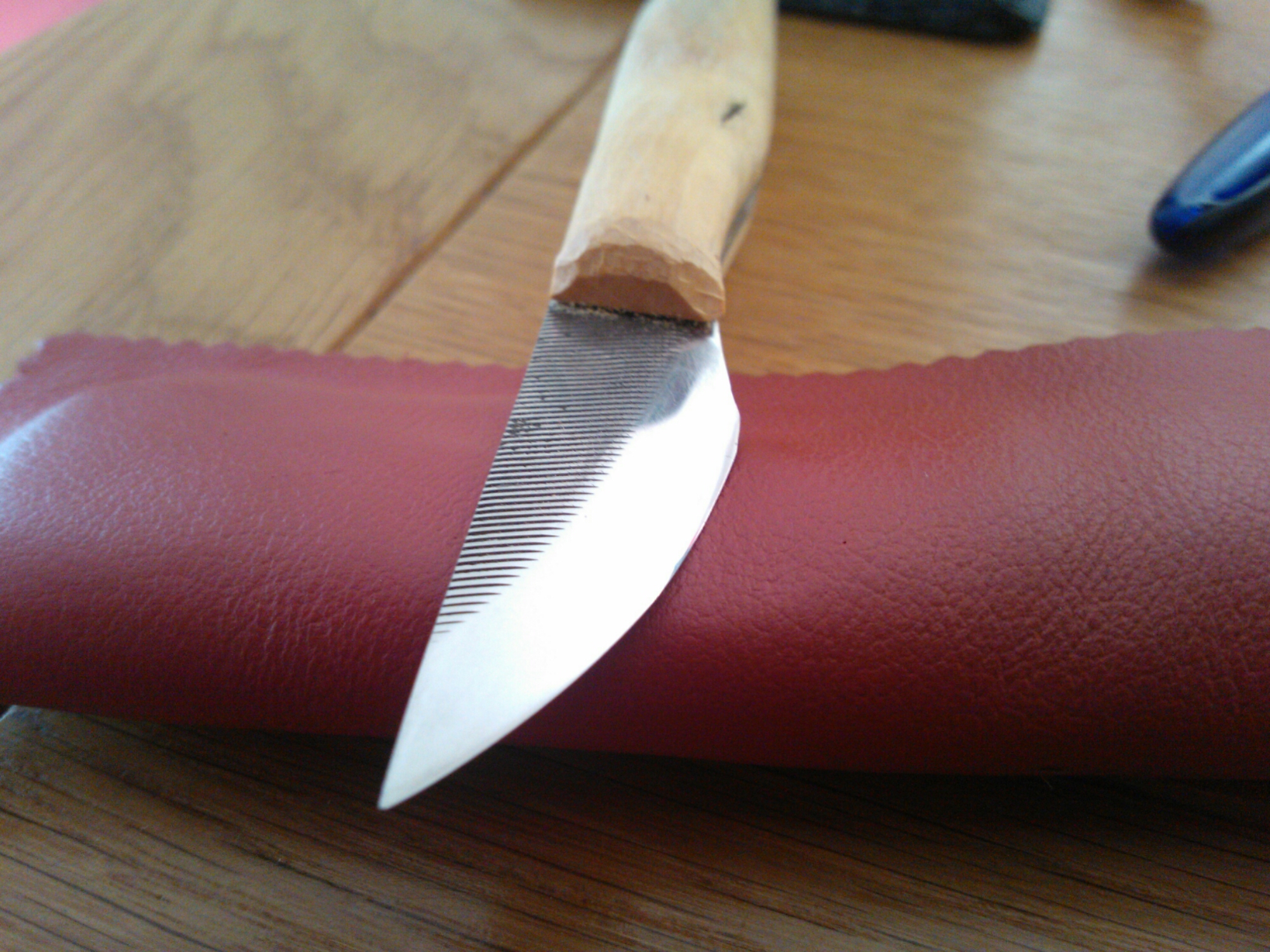
 Carved by Trev